Wholesale Activewear for Resale: How to Build a Profitable Product Mix
Buying wholesale activewear for resale? Learn how to choose sports bras, leggings, shorts, tennis dresses and basics while balancing cost, variety and inventory risk.
Buying wholesale activewear is easy.
Buying the right mix of activewear that your customers will actually buy is much harder.
For wholesalers, boutiques, online sellers and distributors, the goal is not simply to find the lowest-priced leggings or sports bras available.
The real goal is to build an assortment that gives you:
Competitive cost + enough variety + healthy resale margin + manageable inventory risk.
That becomes especially important when you are testing a new category or trying to expand an existing apparel business.
Instead of putting too much money into one product, a better approach is often to build a balanced activewear assortment around different price points, customer needs and selling occasions.
Here is how to do it.
1. Start With Core Products Before Chasing Trends
When building an activewear assortment, it can be tempting to start with the newest colors, unusual cuts or highly trend-driven pieces.
But core products usually give you a stronger foundation.
Think about products such as:
Sports bras
Leggings
Yoga pants
Yoga shorts
Basic fitted T-shirts
Simple active tops
Everyday underwear
These products are easier to understand from a customer's perspective because they fit into everyday wardrobes rather than one specific trend.
EzeeWholesale's current B2B catalog is built around activewear, underwear and everyday basics, with categories including sports bras, yoga pants, tennis dresses, women's T-shirts and women's underwear.
For a reseller, that creates an opportunity to build around dependable categories first and then add more fashion-driven products once you understand what your customers respond to.
2. Use Lower-Cost Products to Create an Entry Price Point
One of the biggest advantages of competitive wholesale pricing is flexibility.
If your cost is low enough, you have more room to decide how you want to sell the product.
You might:
Keep your retail price competitive
Use the item in a promotion
Bundle it with another product
Sell through marketplaces
Offer quantity discounts
Maintain a stronger gross margin
This is why lower-cost basics can be valuable in a wholesale assortment.
At the time of writing, EzeeWholesale's catalog includes selected women's T-shirts from $1.39, sports bras from approximately $1.90, yoga shorts from $1.98, leggings from $2.88, and yoga pants from $3.23. Current prices should always be checked on the individual product page before ordering.
The point is not simply that a lower price is better.
The advantage is what that lower purchasing cost allows you to do with your own pricing strategy.
3. Build Around a Good-Better-Best Product Structure
A simple way to organize your wholesale assortment is to divide products into three levels:
Good: Entry-Level Basics
These are lower-cost, easy-to-understand products.
Examples might include:
Basic sports bras
Simple T-shirts
Yoga shorts
Everyday underwear
These products can help you attract price-sensitive customers and give you affordable options for bundles or promotions.
Better: Core Activewear
This level might include:
Higher-support sports bras
Leggings
Yoga pants
Longline bras
More detailed active tops
These products can become the center of your assortment.
Best: Higher-Ticket Styles
This is where more complete or design-driven products can fit.
For example, EzeeWholesale currently carries several tennis dress styles listed at $9.50 in the wholesale catalog.
A tennis dress naturally sits at a different price point than a basic sports bra or T-shirt.
That is useful.
You do not necessarily want every product in your assortment to have the same cost or selling price.
Different price points allow you to serve different customers and create more upselling opportunities.
4. Think in Outfits, Not Individual SKUs
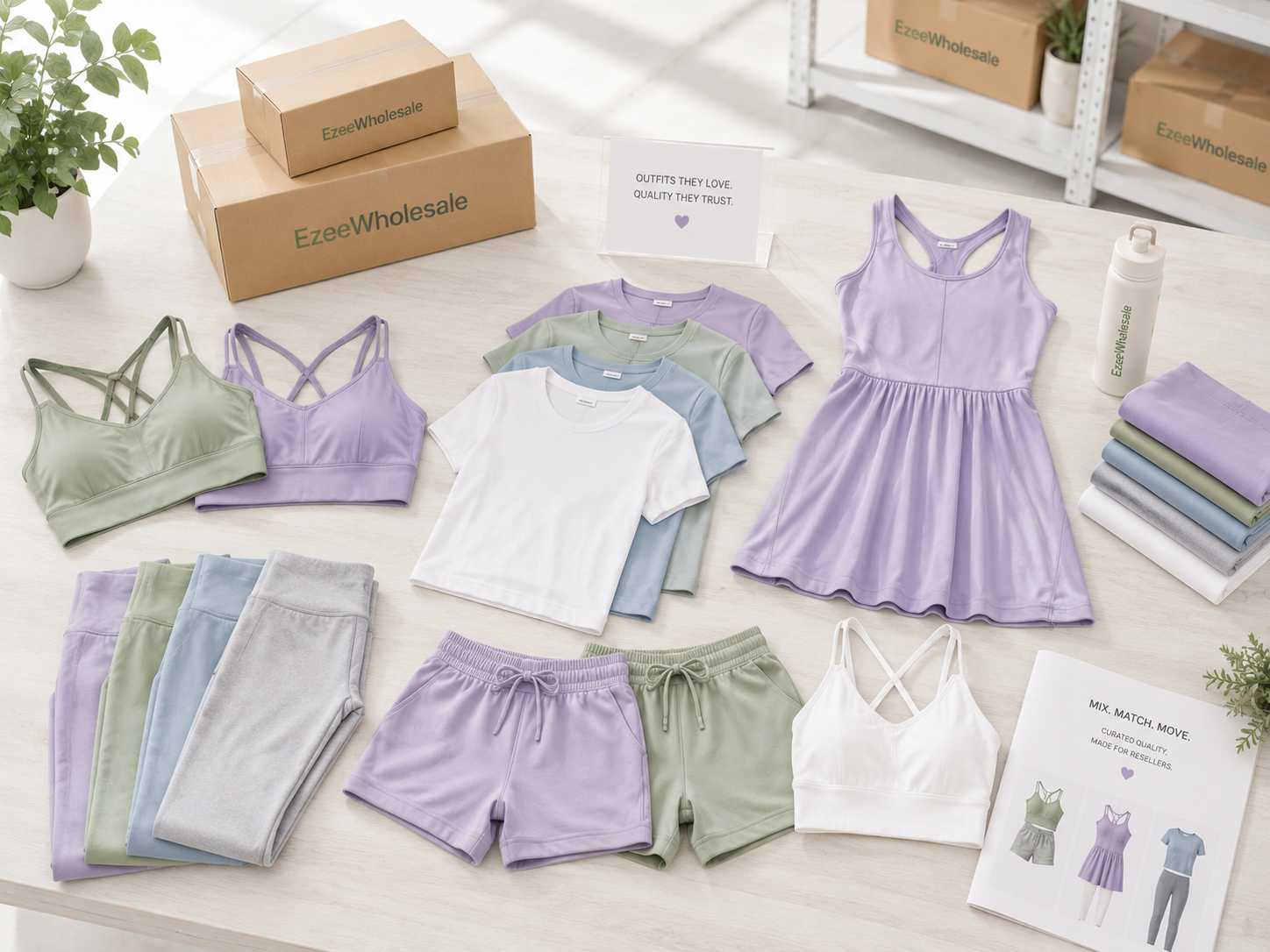
One of the easiest ways to make an activewear assortment feel larger is to select products that work together.
Instead of thinking:
“I need a sports bra.”
Think:
“What can my customer wear with this sports bra?”
For example:
Sports Bra + Leggings
Sports Bra + Yoga Shorts
Fitted T-Shirt + Yoga Pants
Longline Sports Bra + High-Waist Leggings
When buyers see products as part of an outfit rather than isolated SKUs, it becomes easier to merchandise them together.
For resellers, that can create several advantages.
You can:
Create matching-product recommendations
Build bundle offers
Increase average order value
Create more social media content from the same inventory
Encourage customers to purchase a second item
EzeeWholesale's current best-seller assortment includes sports bras, yoga shorts, yoga pants, leggings, T-shirts and tennis dresses, making it possible for buyers to source related activewear categories from the same catalog.
5. Don't Buy Too Many Colors on the First Order
Color variety looks attractive.
But every additional color creates another inventory decision.
Imagine you are buying one sports bra in:
Black
White
Gray
Navy
Pink
Blue
Then you add multiple sizes.
Very quickly, one product becomes dozens of individual SKU combinations.
For an established seller with sales data, that may be manageable.
For a new reseller, it can create unnecessary inventory.
A better approach is to begin with a smaller selection of colors that fit your customer base.
Neutral colors such as black, white, navy and gray can be easier starting points for many activewear assortments.
After you know which colors your customers actually buy, you can expand.
EzeeWholesale's current product catalog shows multiple color options across sports bras, leggings, yoga pants, shorts, T-shirts and tennis dresses, so buyers can compare color availability by individual style.
6. Watch Your Size Curve
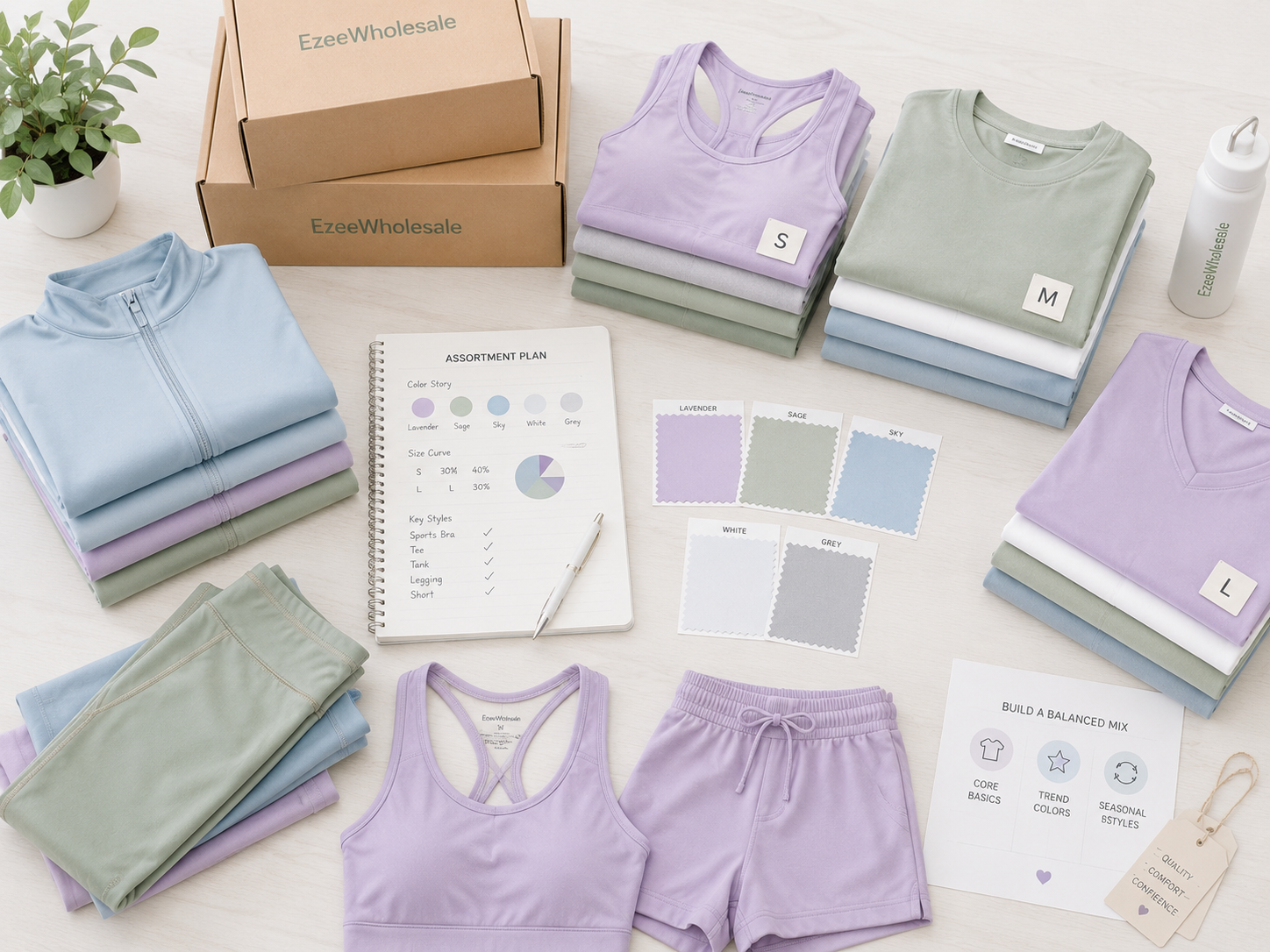
Color gets attention.
Sizing determines whether the product can actually sell.
One of the most common inventory problems in apparel is having plenty of stock overall but not enough stock in the sizes customers want.
That is why buyers should think about the size curve instead of simply dividing an order equally between every size.
For example, selling 100 pieces does not automatically mean that 25% should be Small, 25% Medium, 25% Large and 25% XL.
Your actual mix should depend on your customers.
If you already sell apparel, look at your historical order data.
Which sizes sell first?
Which sizes are frequently left over?
Which sizes produce the most exchanges or returns?
That information should influence your next wholesale order.
For new sellers without data, keep the first order manageable and use it to learn.
Your second order should be smarter than your first.
7. Use Sports Bras as a Flexible Core Category
Sports bras can be particularly useful for activewear resellers because one category can contain many different use cases.
For example:
Low-support styles
Medium-support styles
Higher-support styles
Racerback designs
Cross-back designs
Longline bras
Halter styles
Seamless designs
EzeeWholesale's current sports bra catalog includes multiple constructions and support levels, with examples such as Low Impact Halter, Seamless Cross-Back, Medium Support Cutout Racerback, Thin Strap Racerback Longline and High Support Keyhole Racerback styles.
This means a reseller does not have to depend on one single sports bra design.
You can test several silhouettes and see which type your customers prefer.
That gives you much better information than making a large commitment to one style before you have sales data.
8. Add One or Two Products That Increase Your Average Selling Price
A low wholesale cost is useful.
But your entire assortment should not necessarily consist of the cheapest items available.
You also need products that can support a higher selling price.
Tennis dresses are one example.
Compared with a basic sports bra, a tennis dress is a more complete garment and can occupy a different position in your store.
EzeeWholesale currently offers styles including strappy tennis dresses and open-back tennis dresses, including versions with built-in bras, shorts or removable pads.
For a reseller, adding products like these can help create a more interesting price ladder:
Entry-level basic → Core activewear → Higher-value complete outfit
That gives customers more ways to buy from you.
9. Don't Judge Margin From Wholesale Price Alone
Suppose Product A costs you $2.
Product B costs you $4.
That does not automatically mean Product A is more profitable.
You also need to consider:
Your expected selling price
Marketplace fees
Advertising cost
Packaging
Fulfillment
Shipping
Returns
Discounts
Inventory turnover
A $2 product that sits in inventory for months can be less attractive than a $4 product that sells repeatedly.
A better question is:
How much profit can this product generate relative to the amount of cash I need to keep in inventory?
That is why wholesale buyers should think about price and sales velocity together.
Competitive sourcing gives you room.
Good merchandising determines what you do with that room.
10. Sample Products Before Scaling a Winner
Photos can tell you what a product looks like.
They cannot fully tell you:
How the fabric feels
How the garment stretches
How it fits
How the stitching looks
How the waistband feels
Whether the construction matches your expectations
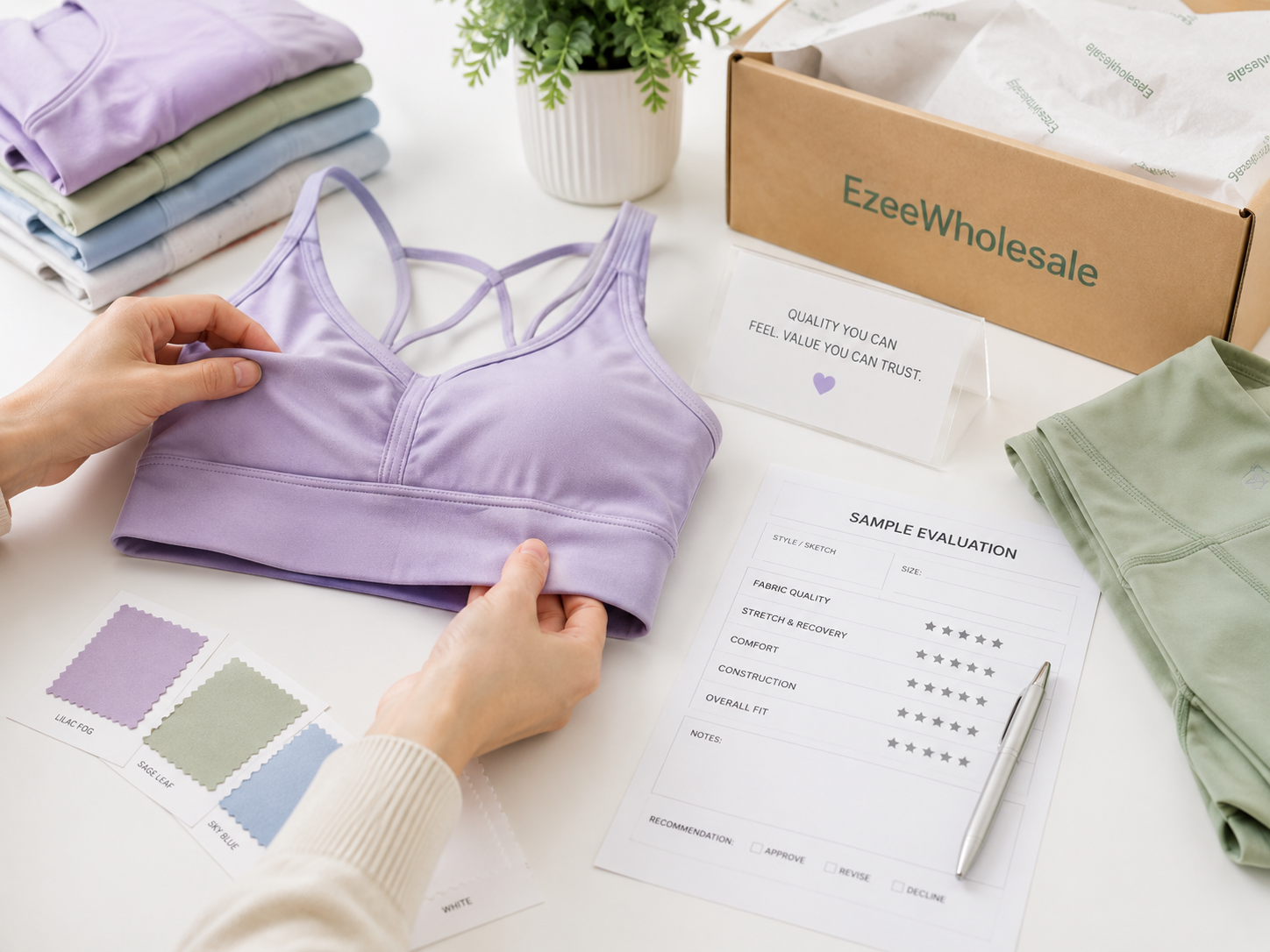
This matters even more with activewear because fit and fabric performance are closely connected to customer satisfaction.
EzeeWholesale allows B2B buyers to submit sample requests for catalog products in order to evaluate fabric, fit, construction and finish. Requests are reviewed individually, and approval, fees and shipping arrangements are confirmed by the team rather than automatically guaranteed.
For a reseller, sampling is useful before making a larger commitment to a product you have never handled before.
11. Scale What Sells Instead of Constantly Adding New Products
More SKUs do not automatically mean more sales.
In many cases, a smaller assortment with strong repeat sellers is healthier than a large catalog full of slow-moving inventory.
After your first selling cycle, divide products into three groups:
Winners
Products that sell quickly and generate repeat demand.
Consider deeper inventory and additional colors.
Potential Winners
Products that sell, but need better merchandising, pricing or positioning.
Test before increasing inventory.
Slow Movers
Products that consistently underperform.
Avoid automatically reordering them just because the wholesale price is attractive.
This creates a simple cycle:
Test → Measure → Reorder Winners → Reduce Slow Movers → Test Again
Over time, your assortment becomes based on actual customer behavior rather than guesses.
12. Move Into Private Label After You Validate Demand
Private label can be a powerful next step for a reseller.
But it does not always need to be the first step.
If you are unsure whether a certain legging, sports bra or activewear category will sell, it can make sense to validate the product concept first.
Once you know what your customers want, customization becomes much more strategic.
You may want to change:
Logo
Labels
Packaging
Fabric
Color
Product details
Brand presentation
EzeeWholesale currently accepts customization briefs covering product focus, quantities, logos, packaging, fabrics and private-label requirements. The team reviews each request and follows up with pricing, feasibility and lead-time information.
That creates a natural progression:
Wholesale product → Market test → Winning style → Custom/private label version
For a growing reseller, that can be much less risky than developing a completely custom collection before knowing what customers want.
A Simple Wholesale Activewear Mix for a New Reseller
If you are starting a new activewear category, you do not necessarily need dozens of styles.
A simple assortment could include:
2–3 Sports Bras
Choose different constructions instead of nearly identical products.
For example:
One basic or low-support style
One cross-back or racerback style
One longline or higher-support style
1–2 Bottoms
For example:
High-waist leggings or yoga pants
Yoga shorts
1 Basic Top
A fitted T-shirt or simple active top gives customers another way to build outfits.
1 Higher-Value Product
A tennis dress or another more complete activewear piece can give the assortment a higher price point.
Then measure the results.
You can always add more products later.
Inventory is easier to expand than it is to undo.
Wholesale Activewear Buying Checklist
Before adding a new product to your assortment, ask:
Does this product fit my existing customer?
What is the wholesale cost?
What selling price can my market support?
What colors should I start with?
Which sizes do I actually need?
Can I merchandise it with another item?
Does it give me enough margin after other costs?
Can I test it before buying deeper inventory?
Is it different enough from products I already carry?
If it becomes a winner, can I reorder or customize it?
If you cannot answer these questions yet, you may not need a larger order.
Final Thoughts
Successful wholesale activewear sourcing is not about buying the most products.
And it is not only about finding the lowest price.
It is about using your purchasing budget intelligently.
Start with core products.
Create different price points.
Select styles that work together.
Test colors and sizes.
Measure what sells.
Then put more inventory behind the winners.
At EzeeWholesale, our B2B catalog focuses on activewear, underwear and everyday basics for the U.S. market, including sports bras, leggings, yoga pants, yoga shorts, tennis dresses, T-shirts and underwear. Buyers can browse current wholesale products or submit sample and customization requests depending on their sourcing needs.
Looking for wholesale activewear for resale? Explore our current catalog to compare styles and pricing, or contact our team if you need help sourcing products for your business.